




How to Make AI Stop Ignoring Your Content for Good
Introduction
And when you are asking yourself how to get AI to pay attention to your work, you are not alone.
Most brands can believe that there is a problem in their visibility or ranking—but this is hardly the case.
The reality is more basic and painful, though: your content is not responding to the queries posed to AI tools. Your pages may be ranked high on Google but AI systems such as ChatGPT, Perplexity, and Gemini are not interested in just optimized pages but in clear, complete and trustworthy answers.
In order to gain a more comprehensive insight into the concepts mentioned in SEO 2026: 5 Ways to Rank Without Backlinks, you might consider enhancing your expertise with a hands-on digital marketing course in Pune intended to be applied in the real world.
Throughout this guide, you can discover why AI ignores the majority of the content, and precisely how you can correct it permanently.
Why AI Search Is Different From Google
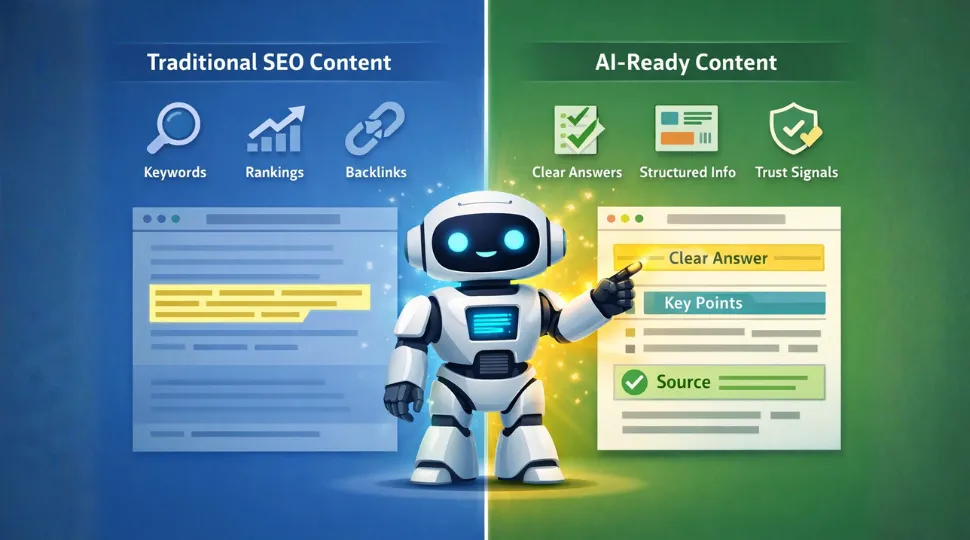
Traditional SEO focuses on:
- Rankings
- Keywords
- Backlinks
- Technical optimization
The search of AI is concerned with another thing altogether.
AI tools look for:
- Direct responses to particular questions
- Contextually detailed explanations
- Verifiable, credible information
- Confidentially reusable content
Unlike Google, AI does not desire to transport the user to ten links, but instead, answers the question instantly.
| Google SEO Focus | AI Search Focus |
|---|---|
| Keywords | Direct answers |
| Rankings | Reusability |
| Backlinks | Trust signals |
| Page authority | Clarity & depth |
| Traffic | Answer quality |
The Real Reason AI Ignores Your Content
Most teams believe:
"We rank, so AI should pick us up."
But AI doesn't care if:
- Your page exists
- Your SEO score is high
- Your content is indexed
AI ignores content when:
- The solution is hidden in fluff
- The reading provides a partial response to the question
- The description is not very clear or authoritative
- No obvious conclusion or lesson
This is the Answer Problem and not a visibility problem.
The "Answer Gap" Most Teams Miss
Having analysed actual prompts according to:
- ChatGPT
- Perplexity
- Google Gemini
A regular trend becomes evident:
- Pages exist
- Rankings are decent
- Answers are incomplete
Example:
Question: What does AI base all their decisions on?
What AI finds:
- Long introductions
- Vague explanations
- No direct framework
It is bypassed by AI not because it is a poor SEO technique, but because it cannot be reused.
How AI Evaluates Content for Reuse
AI systems emphasize on content that illustrates:
Clarity
- Responding to a definite question
- Clear subheadings
- Structured logic
Completeness
- Covers what, why, and how
- Includes examples or steps
- Follow up questions are a natural extension of answers
Trustworthiness
- Author expertise
- Data or citations
- Real-world experience
EEAT (Experience, Expertise, Authoritativeness, Trust) is increasingly important in content assessment—even outside of Google as the Search Quality Evaluator Guidelines state.
How to Audit Your Content for AI Search
Rather than anticipating what AI desires, do this instead.
Step 1: Collect Real Prompts
Use:
- ChatGPT "People also ask" types of prompts
- Questions were proposed out of perplexity
- Google autocomplete
Step 2: Match Prompts to Pages
Ask one brutal question:
Does this page clearly respond to the following prompt—yes or no?
Step 3: Score Your Answers
Rate each page:
- No answer
- Partial answer
- Clear and complete answer
This basic audit indicates the reason AI does not pay attention to the majority of content.
Creating AI-Ready Answers (Step-by-Step)
Start With the Question
Be direct in your content:
- As an H2 or H3
- Or in the opening sentence
Answer Immediately
Don't warm up for 500 words.
Example:
AI discards content that does not have clear and complete answers that can be reused with certainty.
Expand With Context
Then explain:
- Why it happens
- How it impacts visibility
- What to do instead
End With a Clear Takeaway
AI is fond of quotes or adaptations.
Examples of Content AI Does Pick Up
AI often reuses content which contains:
- Step-by-step frameworks
- Definitions with context
- Comparison tables
- Short summaries
Example Structure:
- Definition
- Why it matters
- How it works
- Common mistakes
- Quick summary
This is a type of thinking that AI follows.
EEAT Signals That Matter for AI Visibility
To improve trust signals:
Experience
- Share firsthand insights
- Employ actual audits, experiments or observations
Expertise
- Use precise terminology
- Explain why, not just what
Authority
- Name identified tools, platforms, or structures
- Link to credible sources
Trust
- Avoid exaggerated claims
- Maintain data quality and up-to-date
Even minor additions, such as screenshots, snippets of cases, or examples, make AI more sure about reusing your material.
Common Mistakes to Avoid
- Writing to questions rather than writing to keywords
- Hiding replies in the middle of the paragraphs
- Optimizing headlines without enhancing content
- Negligence in regard to prompt intent
- Ranking instead of AI visibility
Final Thoughts
When you are asking how to ensure AI does not shun your content, you need to stop focusing on visibility tricks and begin to correct answers.
AI search rewards:
- Clear thinking
- Honest explanations
- Complete responses
Whether you're considering a digital marketing course in Thane or exploring digital marketing classes in Pune, choosing an affordable digital marketing course in PCMC can help you learn industry-ready skills without overspending.
Respond to the question better than anyone else—and AI will take notice.
"People don't want more information. They want better answers."
— Satya Nadella, CEO of Microsoft
FAQs About AI Search Optimization
1. Will ranking on Google ensure the visibility of AI?
No. Ranking is beneficial to discovery, whereas AI focuses on the quality of answers.
2. What should the length of AI-friendly content be?
Sufficient to respond to the prompt to completion—usually 800-2000 words, varying with complexity.
3. Are backlinks relevant to the AI search?
Less than before. It is more about clarity, trust and completeness.
4. Is it possible to optimize old content with the help of AI?
Yes. It is not always necessary to publish new pages, it is better to update old ones.